How We Went From 60s to 90s: Our Simple Quest-Style Exam Prep Routine
A working mum's honest account of how two exam subjects went from mid-60s to 90s in a single cycle — using short sessions, active recall, and a process our son actually wanted to do.
Key Takeaways
- A bright child scoring in the 60s and 70s is not a capability problem — it is often a motivation and method problem.
- Short, focused study sessions of 15–20 minutes beat long, exhausting homework marathons every time.
- Active recall (quizzing) closes knowledge gaps faster than re-reading notes.
- Aligning study material to your child’s actual school notes — not a generic curriculum — makes a measurable difference.
- In two subjects where we ran this process, our son went from mid-60s to 90s in a single exam cycle.
Table of Contents
- The Reality Behind Those 60s and 70s
- Why Generic Study Apps Were Not the Answer
- The Experiment: Turning School Notes Into a Quest
- The 20-Minute Rule: Why Short Sessions Work
- From Passive to Active: The Shift That Changed Everything
- The Knowledge Gap Framework: Red, Yellow, and the Weekend Mission
- The Results: Two 90s and a Kid Who Wanted to Study
- What This Means for Your Child’s Exam Prep
- Exam Prep for Primary School: A Complete Overview
- Try Sparkquest With Your Child
- FAQs About Exam Prep for Primary School
The Reality Behind Those 60s and 70s
My son is one of the sharpest kids I know. He picks up sports fast, he remembers things you told him months ago, and he can hold a conversation that surprises you. But his report cards told a different story — 60s, the occasional 70, and a pattern that had settled in like furniture.
For a long time, my wife and I told ourselves it was fine. He was passing. He was happy. But we both knew, quietly, that the numbers did not reflect who he actually was.
The problem was not intelligence. It was the gap between what he was capable of and what he was willing to sit down and do. The moment homework looked like work — like a chore, like something being done to him rather than by him — he was gone. Mentally checked out, physically present, pencil in hand but eyes somewhere else entirely.
And we were not helping as much as we wanted to. Both of us work. By the time we got home, made dinner, and sorted out the evening, we had maybe 30 minutes of real energy left. Sitting beside him to explain a concept he had already half-forgotten from school was not always something we could do well. We are not teachers. We are parents who love our kid and were running out of ideas.
That is where this story starts.
Why Generic Study Apps Were Not the Answer
Before we built anything, we looked at what was already out there. There are plenty of apps for kids — quiz tools, maths games, reading comprehension builders. Some of them are genuinely well-made.
But here is the problem we kept running into: they all had their own curriculum.
A maths app built around the UK curriculum. A comprehension tool designed for American grade levels. A science quiz that covered topics his class had not touched yet, or skipped the ones they had spent three weeks on.
None of them knew what his teacher had written on the board last Tuesday. None of them had seen his Social Studies notes or knew that his History class had focused on a specific set of topics for this term’s exam. They were built for a general child, not for him.
We are based in Nigeria. His school follows its own syllabus, its own pacing, its own way of framing concepts. A generic app could not bridge that gap, no matter how polished it looked.
What we needed was something that could look at his actual notes — the pages he brought home from school — and build the study experience around exactly that. Not a pre-packaged plan. Not someone else’s curriculum. His work, his scope, his exam.
That was the idea behind SparkQuest.
The Experiment: Turning School Notes Into a Quest
The version of Sparkquest we tested was not pretty. It was a working prototype, not a finished product. But it could do the one thing we needed: take pictures of school notes and turn them into a quiz that mapped directly to what he was being tested on.
For two subjects — Social Studies and History — we photographed his study notes. Both sets were substantial: around 25–26 pages each, front and back, covering everything his teacher had gone through that term. We uploaded those pages and let the system read them.
From those notes, it generated a quiz for each subject. The questions were not invented from a database somewhere. They came directly from his material — the same concepts, the same terminology, the same scope his teacher would be testing him on.
He sat down on a Friday evening and took both quizzes.
Each one took him about 30 to 35 minutes — longer than ideal, and that was partly because we had uploaded so much material at once. In a more refined routine, we would have broken it into smaller chunks across the week. But even at that length, something was different. He was engaged. He was reading the questions, thinking, answering. He was not asking to stop.
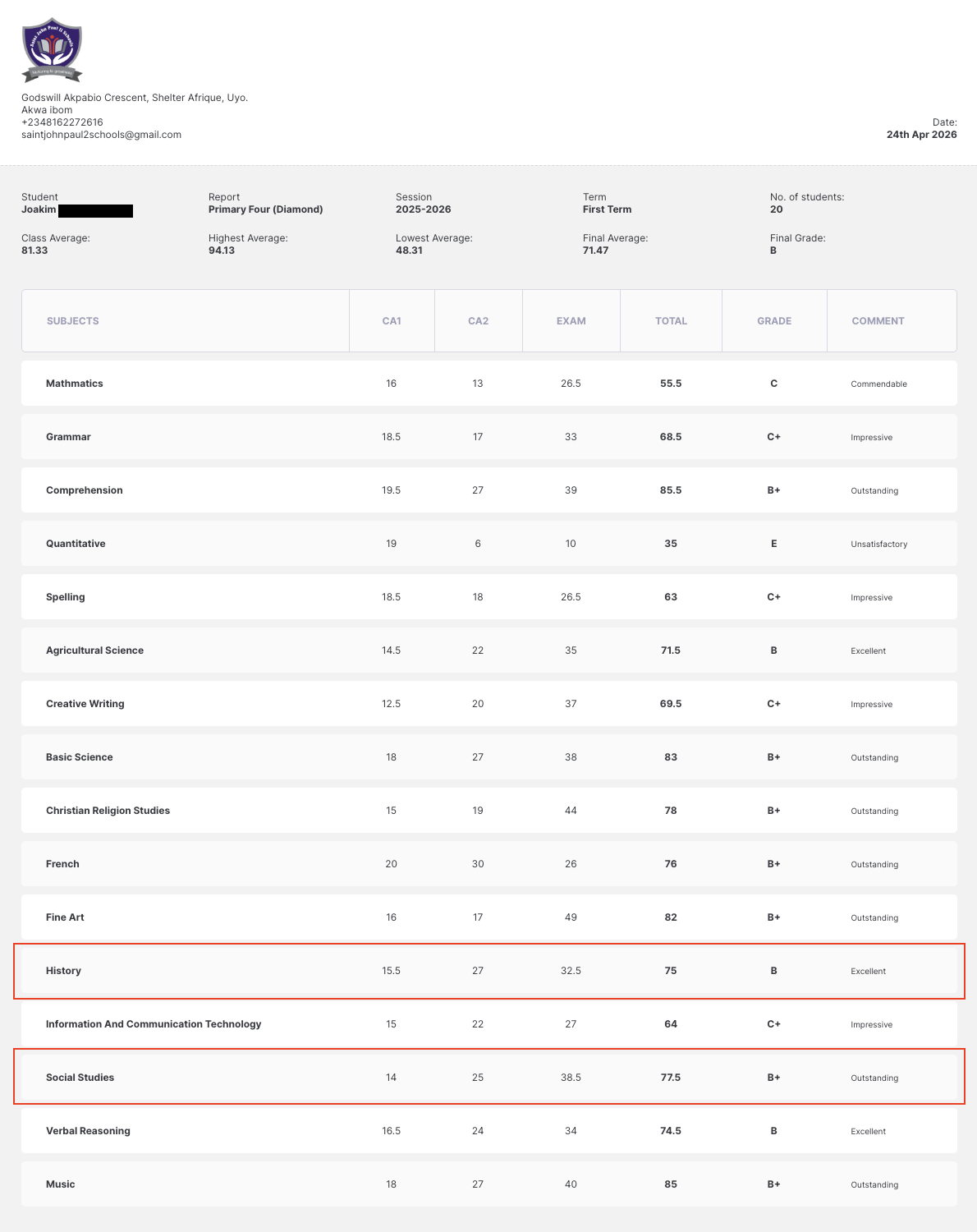
He scored in the mid-60s on both — about where his exam results had been sitting.
But now we had something we had never had before: a clear picture of exactly what he did not know.
The 20-Minute Rule: Why Short Sessions Work
One of the clearest findings from research on how children learn is that shorter, focused sessions outperform long, grinding ones. For primary school children, 15 to 20 minutes of active, engaged study is more effective than an hour of passive re-reading. Attention holds, retention improves, and — critically — the child does not associate studying with exhaustion.
This is what we built the weekend routine around.
After the Friday quiz, we did not ask him to sit down for hours. We told him he had two days — Saturday and Sunday — and a specific goal: work through the missions the app had flagged in red. Not everything. Not a marathon. Just the red ones.
Each mission was short. A concept, an explanation, a few follow-up questions. He could finish one in 15 to 20 minutes and feel like he had accomplished something. Then he could go play. Then come back later.
That rhythm — short burst, clear goal, visible progress, break — is what kept him coming back without being pushed. It is the same principle behind why children can spend an hour on a video game without noticing the time. The sessions feel manageable because they are.
By Sunday evening, he had worked through every red-flagged concept. Not because we forced him. Because the app made it feel like a quest he was completing, and he wanted to finish it.
From Passive to Active: The Shift That Changed Everything
Most children study by re-reading. They go through their notes, maybe highlight a few things, and feel like they have done the work. It feels productive. It is not.
Re-reading creates familiarity, not understanding. You recognise the words on the page, but that is not the same as being able to recall them under exam conditions when the page is gone.
Active recall — being asked a question and having to retrieve the answer from memory — is one of the most well-supported methods in learning research. It forces the brain to work. It surfaces what you actually know versus what you only think you know. And it is uncomfortable in a way that re-reading is not, which is exactly why it works.
The quiz on Friday was active recall. He was not reading his notes again. He was being asked questions and having to produce answers. The gaps that appeared were real gaps — not things he had skimmed over, but things he genuinely could not retrieve.
The missions over the weekend were also active recall. The app did not just show him the answer. It walked him through the concept, asked him to engage with it, and then checked whether he had understood. He was not copying. He was thinking.
This shift — from passive re-reading to active quizzing — is the single biggest change in how he studied. Everything else supported it, but this was the core.
The Knowledge Gap Framework: Red, Yellow, and the Weekend Mission
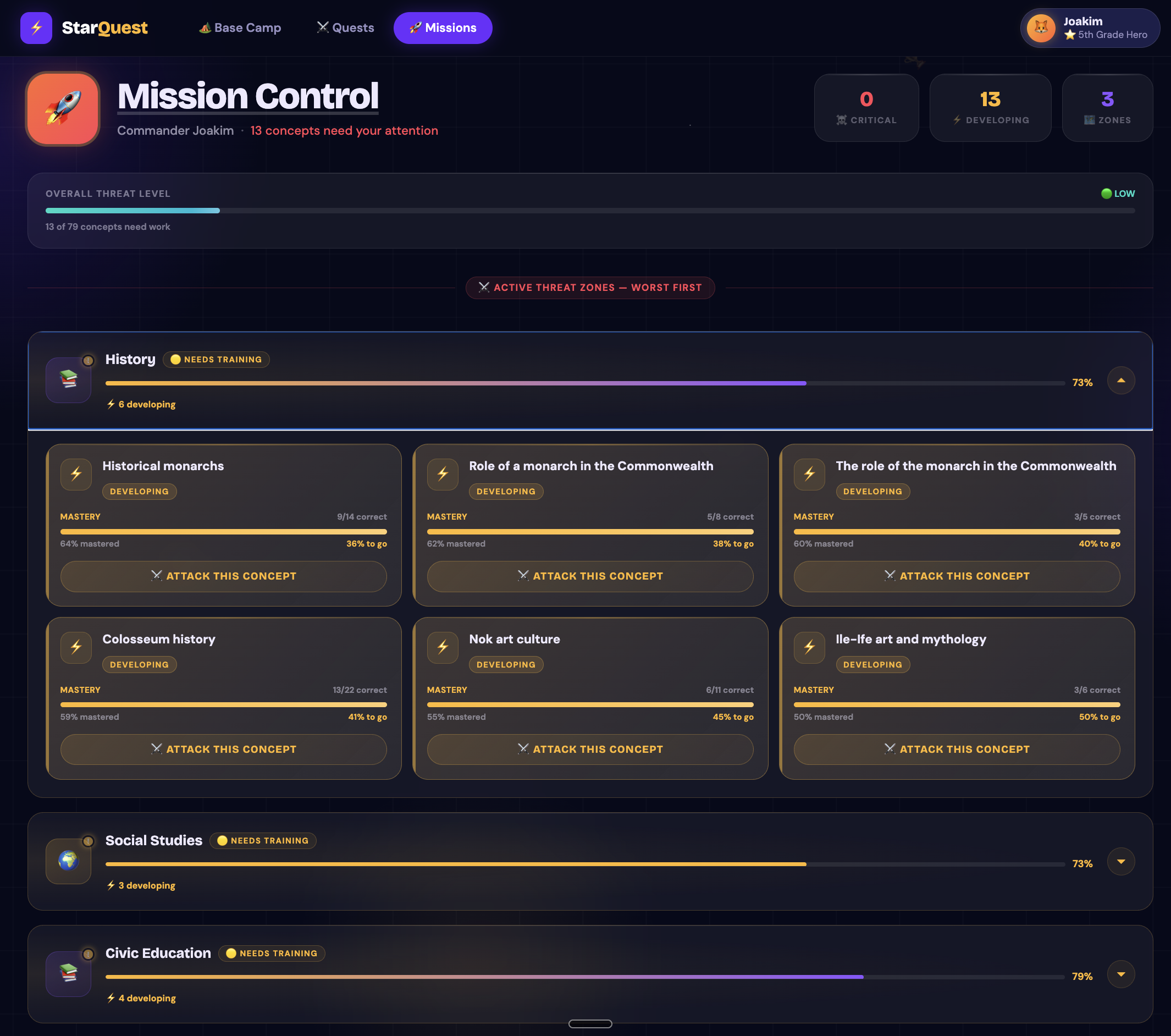
After the Friday quiz, the app sorted every concept into one of two categories.
Red meant he had not demonstrated understanding of that concept. It was a gap — something the exam could ask about that he was not ready for.
Yellow meant he had partial understanding. Not solid, but not empty either.
I explained it to him in those terms. Red means “I don’t know this yet.” Yellow means “I’m getting there.” The goal for the weekend was not to turn everything green. It was to move everything red to yellow. That was the mission.
This framing mattered more than I expected. It gave him a concrete, achievable target. He was not studying “for the exam” in some vague, anxious way. He was completing missions. He could see the list. He could see it getting shorter. He could see himself making progress in real time.
By Sunday, every red concept had moved to yellow. He had not mastered everything perfectly — yellow is not perfect — but he had closed the gaps that mattered most. The things that had been completely dark were now at least lit.
The exam was on Monday.
The Results: Two 90s and a Kid Who Wanted to Study
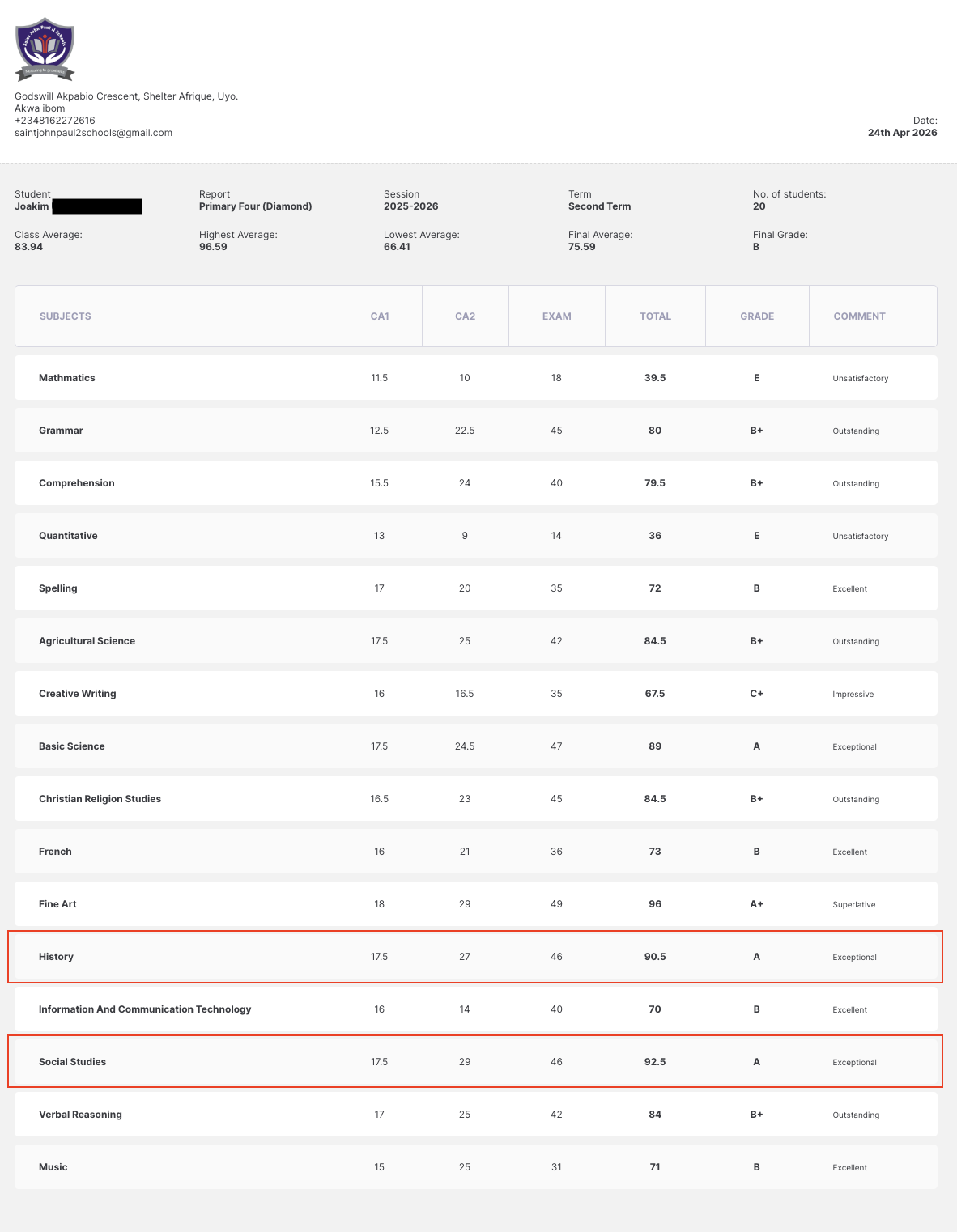
When the results came back, Social Studies and History were the two subjects that stood out.
He scored 90 in both.
Current Terms Results below
Previous Terms Result
He also scored 96 in Fine Art that cycle — though we had not used the process for that subject, so we cannot attribute it to the same method. The two subjects where we ran the full process were Social Studies and History, and those were the ones that moved.
The other subjects, where we had not used the process, came back in the range we were used to. Not bad. Not 90s.
I want to be honest about what this was and was not. It was one exam cycle. Two subjects. A prototype, not a finished product. We are not claiming this is a controlled scientific study.
But it was also the first time my son had ever scored 90 in either of those subjects. It was the first time I watched him sit down to do school work without being asked. It was the first time he came to me on a Saturday morning and said he wanted to finish his missions.
That last part — a child choosing to study — is not something you can manufacture with pressure or rewards. It happened because the process felt like something worth doing. That told us we were onto something real.
What This Means for Your Child’s Exam Prep
If your child is sitting in the 60s and 70s and you know they are capable of more, the answer is probably not more hours at the desk. It is a better method in the time they already have.
Here is what the process looked like, stripped down to its core:
Before the exam (ideally one week out): Take photos of your child’s school notes for the subject being tested. Upload them. Let the system generate a quiz based on exactly what they have been taught.
Day one (Friday in our case): Sit down for one quiz session. 30 minutes maximum. Do not worry about the score. The score is just a map.
Days two and three (the weekend): Work through the red-flagged concepts only. Short sessions, 15–20 minutes each. Let the child set the pace within the day. The goal is to move red to yellow, not to achieve perfection.
Exam day: Go in with the gaps closed. Not with everything memorised perfectly, but with the blank spots filled in.
This is not a magic fix. A child still needs to engage, still needs to think, still needs to put in the time. But the time is shorter, the direction is clearer, and the process is one they can actually want to do.
That combination — short, targeted, active, and genuinely engaging — is what exam prep for primary school should look like.
Exam Prep for Primary School: A Complete Overview
| Element | What It Means in Practice |
|---|---|
| Best session length | 15–20 minutes of focused, active work per session |
| Study method | Active recall (quizzing) over passive re-reading |
| Material alignment | Use your child’s actual school notes, not generic curricula |
| Knowledge gap tracking | Identify what they don’t know before the exam, not after |
| Gamification | Frame study tasks as missions with visible progress |
| Parent’s role | Set up the process and encourage; avoid becoming the tutor |
| Ideal start time | 5–7 days before the exam for best results |
| Red concepts | Topics with no demonstrated understanding — address these first |
| Yellow concepts | Topics with partial understanding — revisit if time allows |
| What to avoid | Long cramming sessions, re-reading without testing, generic apps misaligned to your child’s school |
| Proof of concept | Two subjects, one weekend, mid-60s to 90s in both |
Try Sparkquest With Your Child
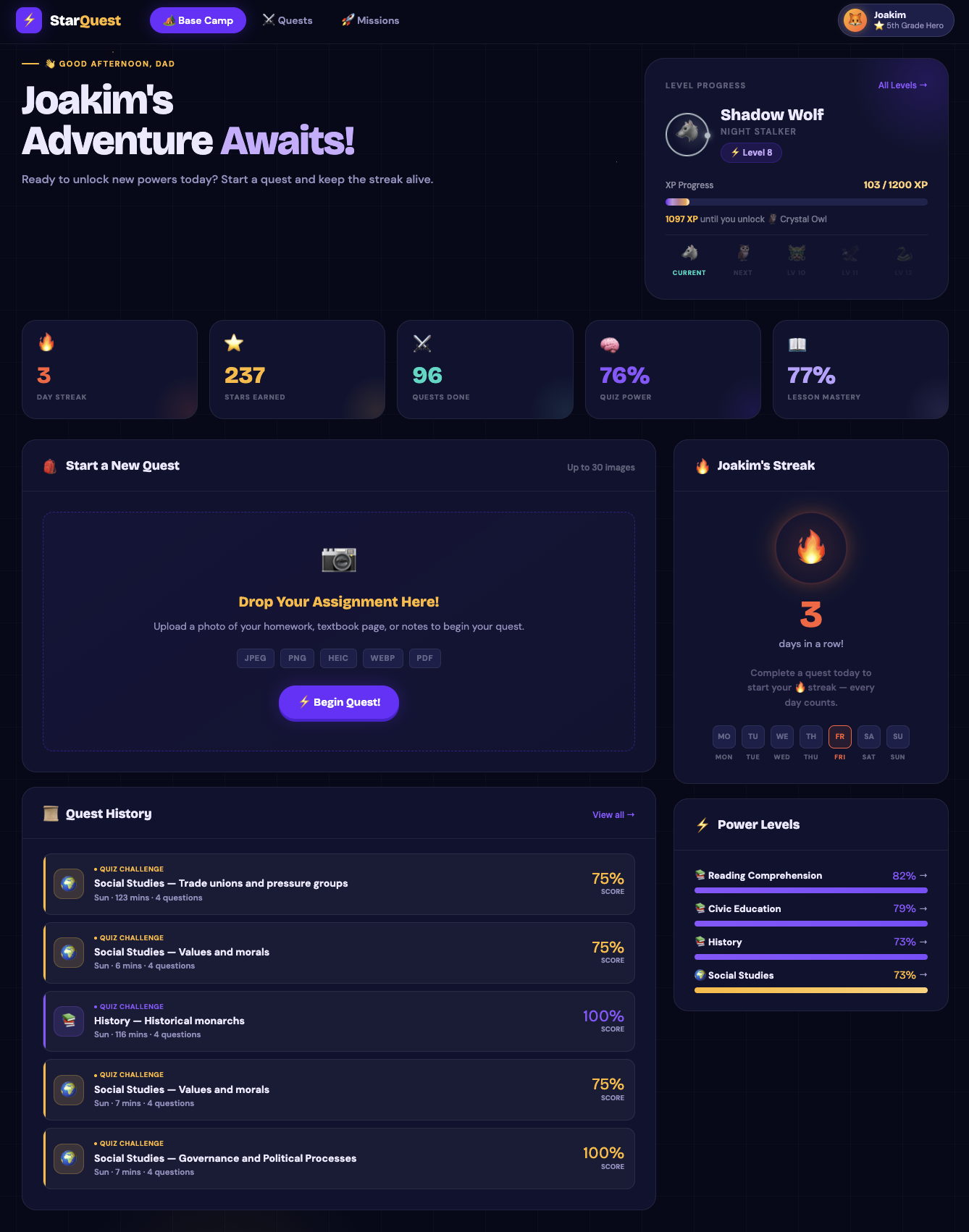
Sparkquest was built by a mum who needed something that did not exist yet — a study tool that works from your child’s actual school notes, tracks what they know and what they don’t, and turns the whole process into something they want to do.
It is not built for a generic child in a generic classroom. It is built for your child, with their notes, for their exam.
Here is what makes it different from everything else we found:
It starts with your child’s real material. You photograph their notes. The quizzes come from those notes. The concepts being tracked are the ones their teacher will test them on — not a pre-packaged syllabus from another country.
It shows you exactly where the gaps are. Not a vague score. A specific list of concepts your child does not yet understand, sorted by urgency, with missions to close each one.
It makes the child want to do it. The quest structure, the visible progress, the short missions — these are not cosmetic features. They are the reason a child will sit down on a Saturday morning and ask to finish their missions before going out to play.
Sparkquest is built for the mum or dad who is busy, who loves their child, and who wants a process that works without turning every evening into a battle.
FAQs About Exam Prep for Primary School
How long should a primary school child study each day before an exam?
For exam prep at primary school level, 15 to 20 minutes of focused, active study per session is more effective than longer, unfocused ones. Research on children’s attention and retention consistently supports shorter, more frequent sessions over marathon study blocks. Two 20-minute sessions in a day – one in the afternoon and one in the evening – is a strong target for the week before an exam.
The key is that the time is spent actively recalling information, not passively re-reading notes. Consistency across several days matters more than the total hours logged in one sitting.
What is the best way to prepare my child for primary school exams at home?
The best way to prepare your child for primary school exams at home is to combine active recall with material that match what their teacher has covered. Start by identifying what your child does not know – through a quiz or practice questions – rather than assuming re-reading their notes is enough.
Use short, focused sessions of 15 to 20 minutes and give your child a specific, achievable goal for each one. Align the study material to their actual school notes and syllabus, not a generic app or textbook. The parent’s role is to set up the process and offer encouragement, not to act as a full-time tutor.
Why does my child score low on exams even though they seem to understand the work?
A child can seem to understand material during revision but still score low on exams because familiarity is not the same as recall. When a child re-reads their notes, the information feels familiar – but under exam conditions, without the notes in front of them, they cannot retrieve it.
This is one of the most common gaps in how children study. The fix is to shift from re-reading to active recall: close the notes, ask questions, and require the child to produce answers from memory. Doing this before the exam surfaces the real gaps while there is still time to close them.
How do I make exam revision less stressful for my child?
Making exam revision less stressful starts with making the sessions short and the goals specific. A child who sits down knowing they have to “study for the exam” has no clear finish line – that ambiguity creates anxiety. A child who sits down knowing they have three missions to complete has a target they can reach.
Framing mistakes as information rather than failure also helps: a wrong answer is not a problem, it is a signal that tells you exactly what to work on next. Keeping sessions to 15–20 minutes and building in breaks preserves energy and keeps the child’s relationship with studying positive.
At what age should children start preparing for school exams?
Children can begin structured exam preparation from around age 7 to 8, which typically corresponds to primary school years 2 to 3. At this stage, the preparation should be light – short quizzes, simple recall games, and reviewing key concepts rather than intensive study.
By ages 9 to 11, children can handle more structured sessions with clear goals and knowledge gap tracking. The approach should always match the child’s attention span and emotional readiness, with the emphasis on building confidence and familiarity with the exam format rather than pressure to perform.
How many days before an exam should a child start studying?
Starting exam prep 5 to 7 days before the exam gives enough time to identify knowledge gaps and close them without cramming. Beginning on the Friday before a Monday exam – as we did – allows for a diagnostic quiz on day one and two full days of targeted revision over the weekend. Starting earlier than a week out is useful for subjects with a large scope of material. Starting the night before is the least effective approach for primary school children, as it creates anxiety and does not allow time for spaced practice across multiple sessions.
Can gamified learning actually improve exam scores?
Gamified learning can improve exam scores when the gamification is tied to genuine understanding rather than surface-level completion. In our case, the quest structure – missions, visible progress, red and yellow concept tracking – kept our son engaged long enough to do the active recall work that actually builds retention.
The gamification was not a substitute for the learning; it was the delivery mechanism that made him willing to do it. Studies on motivation in children consistently show that autonomy, visible progress, and a sense of achievement increase time-on-task, which in turn improves outcomes.
What if my child just copies the answers instead of actually learning?
SparkQuest reduces the risk of simply copying answers by guiding students through steps and follow-up questions that require real engagement with concepts. Instead of just giving answers, the system integrates homework questions into the lessons to help children understand material as they work.
Knowledge gaps can’t be faked, since they show up again if not mastered. Lessons adapt to address misunderstood topics in different ways, ensuring the child truly comprehends each concept before moving on.
Can this approach work if I don’t have much time to sit with my child?
This approach was built specifically for parents who do not have much time. The setup – photographing notes and uploading them – takes 10 to 15 minutes. After that, the child works through their sessions independently, with the app guiding the process.
The parent’s role shifts from explaining concepts to checking in on progress and offering encouragement. You do not need to understand the material yourself or be available for every session. The system handles the repetitive work of quizzing and concept explanation so that the time you do spend with your child is focused on connection, not correction.
About the Author
Vanessa Ikot is the founder of SparkQuest and a working mum based in Nigeria. She built SparkQuest after watching her son – a bright, capable kid – consistently underperform on exams not because of a lack of ability, but because traditional study methods did not hold his attention.
Her approach to learning is grounded in what actually worked for her own child: short sessions, active recall, and a process that feels worth doing.
She writes about practical exam prep, parenting through the homework years, and building products that solve real problems.